There’s a moment every product leader knows too well: your strategy is solid, your data story is tight, your AI prototype actually works, and then the room goes quiet. No one says “no,” but no one really says “yes” either.
You’re not imagining the cost of that silence. According to McKinsey research, about 70% of complex, large-scale transformation programs fail to reach their stated goals (1). In mid-to-large tech companies, good ideas rarely die because you can’t get the right people to bet their political capital on them.
Now layer AI product strategy and AI-powered tools… They all touch risk, jobs, data, and brand. That means you can’t just “ship and see”.
In this piece, you’ll learn how to get buy-in from stakeholders for product strategy, product roadmaps, and AI initiatives, including how to frame the story, which mistakes quietly kill support, and how AI prototyping itself can become your strongest ally in winning the room.
Turning AI Doubt into AI Strategy
Ryan Daly Gallardo, SVP of Product, Consumer at Dow Jones, reveals how to test without eroding trust, embed cross-functional safeguards, and use evidence-based design to deliver AI features that improve engagement.
Download Playbook
What Does it Mean to Get Buy-In From Stakeholders?
Getting buy-in from stakeholders means that the people who can block, fund, or reshape your work actively support it. Not just “they heard your deck.” Not just “they did not object.” It means they understand the problem, believe your solution is the right bet, and are willing to spend political and financial capital to help you make it happen.
In practice, stakeholder buy-in is when your CFO defends your product roadmap in the budget meeting, your CTO fights to keep your AI infrastructure investment off the chopping block, and your GTM leaders actually plan product launch strategy around what you ship. Without that level of backing, even the smartest product strategy becomes slideware.
How AI changes the game for stakeholder buy-in
Before AI, buy-in mostly meant: “Will this roadmap help us hit revenue and customer targets?” Today, the questions sound more like:
How does this AI initiative move our core business metrics, not just vanity “AI usage” numbers?
What data, governance, and security constraints do we need to respect?
Is it better to build it ourselves or buy a ready-made solution?
What happens to existing teams, roles, and vendors if this works?
At the same time, AI gives you new tools to earn trust faster:
You can use AI prototyping to show realistic flows instead of hand-wavy visions.
You can simulate impact with scenarios and synthetic data instead of arguing in the abstract.
You can use AI-generated summaries to keep busy execs aligned on decisions, risks, and trade-offs.
So the meaning of buy-in has not changed. But the bar has. In AI-heavy environments, stakeholders are not just backing a project. They are backing a direction of travel that will reshape how the company operates and where its talent goes next.
How To Get Buy-In From Stakeholders: 7 Ways to Ensure You Receive Buy-In
There are several ways to secure buy-in from stakeholders, including connecting your product or AI initiative directly to their goals, demonstrating credible paths to impact, and mitigating the perceived risk of saying “yes.”
Getting buy-in from stakeholders means doing three things well:
Understanding who is in the room
speaking their language
De-risking the bet with evidence and prototypes
AI makes this both harder and easier. Harder, because the tech is new and full of hype. Easier, because you can now generate realistic AI prototypes, scenario analyses, and run product experimentation much faster than before. The product leaders who consistently get buy-in are the ones who use AI to compress the “talking” phase and extend the “showing, testing, and learning” phase.
Now, we’ll walk you through practical ways to get stakeholder buy-in for your product and AI bets. Once you’ve gone through these, the chances are you’ll spend less time convincing people in meetings and more time actually shipping.
1. Identify your key stakeholders
First, figure out whose buy-in truly matters. In a mid-to-large product-led organization, you might have a long list of interested parties. Think senior management, engineering, product design, product marketing, sales, operations, finance, and more.
Trying to secure everyone’s approval on every decision is impractical and will slow you down. Instead, focus on the key stakeholders who have high influence and high interest in the outcome (often called “players” in stakeholder analysis). These are the people whose support you must have. For example, an executive sponsor who controls budget, or a department head who will execute the plan.
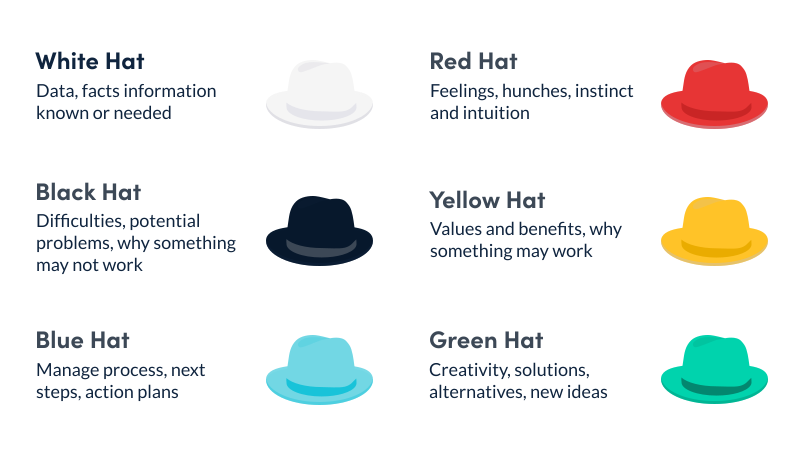
Perhaps, you can use the “Six Thinking Hats” method, developed by Edward de Bono, to approach the challenge of listing stakeholders from different angles and perspectives.
A quick tool that can also help is a Power-Interest Grid, which maps stakeholders by their level of authority and interest.
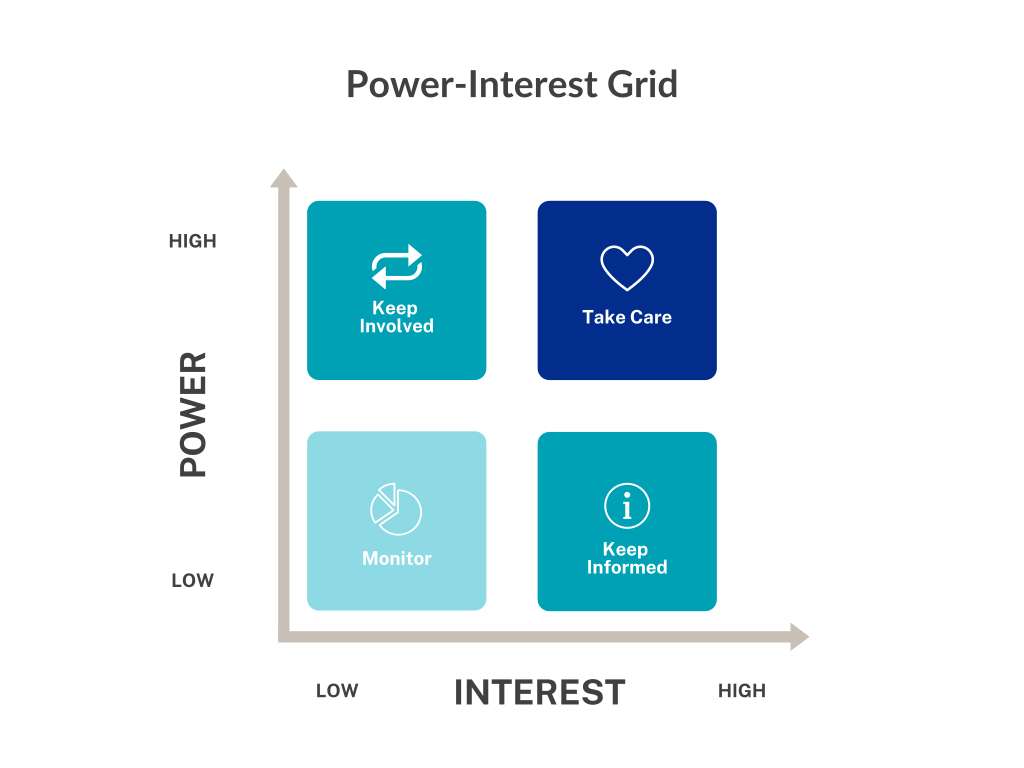
Those with both high power and high interest are your primary targets for buy-in. Make sure to keep others informed, but prioritize your time and relationship-building with the key players who will make or break your initiative.
2. Build relationships, not just roadmaps
Don’t rush straight into pitching your outcome-based roadmap without building rapport. Stakeholders are far more likely to support you if they know, like, and trust you. It pays to invest time in genuine relationships (learning about their goals, constraints, and even personal working styles) before you ever ask for anything.
As Jay Lee, Head of Product Experience at the NBA, wisely said on The Product Podcast:
What I have found is that relationships are better than roadmaps. Understanding who your stakeholders are, who your partners are, and what's important for them is crucial. Establishing that first and investing in those relationships to understand what's at stake for your partners and your stakeholders will push your initiative further.”
Lee’s point is a powerful reminder that empathy and trust are the foundation of buy-in.
Take the time to have one-on-one conversations with your stakeholders early on. Ask questions about their priorities and pain points. Listen actively and acknowledge their perspectives.
For example, if you’re proposing a new AI product feature to a sales leader, first understand her revenue targets or concerns about customer impact. This relationship-building not only gives you valuable insight to shape your proposal, it also shows stakeholders that you value their success as part of your shared mission.
When people feel heard and respected, they’re more inclined to support your ideas. In short, get to know your stakeholders as people. Build trust before you build slides. Strong relationships will carry you through any disagreements during the project.
3. Speak the language of business value to get a stakeholder buy-in
Once you have solid relationships, make sure you communicate your proposal in terms that resonate with your stakeholders. Tailor your message to address what each stakeholder cares about.
An executive might be concerned with high-level business impact (revenue growth, costs, market share), whereas an operations manager might focus on efficiency and risk. Frame your idea in their language.
As President of Technology at WMG, Ariel Bardin advises on The Product Podcast, don’t get stuck speaking in features and tech jargon. Rather, translate those features into the business levers that matter to decision-makers:
You want to talk impact? Translate features into business levers. Growth, margin, new revenue, retention. That’s what wins executive alignment.
In practice, this means link your project to concrete outcomes, not outputs. If you’re pitching an AI-driven product recommendation engine to your CMO, emphasize how it could lift conversion rates or customer lifetime value, not just that it’s a cool algorithm.
If a stakeholder is a “numbers person” who loves data, come armed with a MoSCoW analysis or ROI estimates. If another stakeholder responds better to stories, paint a narrative of how the change will improve a day-in-the-life for them or their team. The key is to frame the benefits in terms that align with your stakeholders’ OKRs and pain points.
On the last note, based on our internal experience, successfully persuading different people often meant customizing the pitch for each audience. For example, highlighting cost savings and a single helpdesk solution to appeal to a university dean, versus technical reliability and uptime to convince an IT director.
So do your homework. Find out what each stakeholder values (financial gains, user satisfaction, risk avoidance, etc.) and explicitly connect your project to those outcomes.
ROI Calculator Template
Calculate ROI with this free, interactive template and built-in calculator to maximize business impact.
Get the Template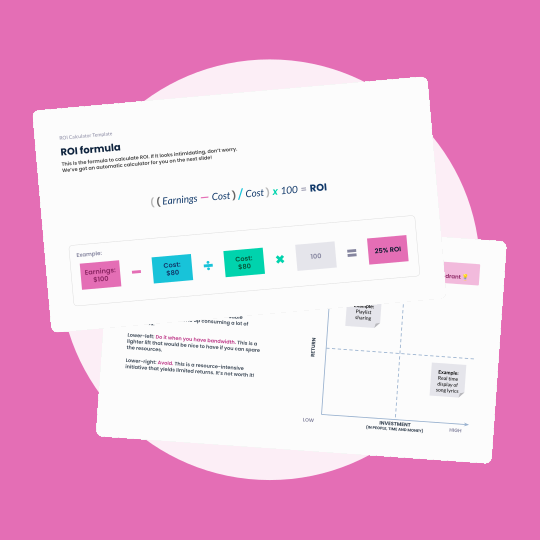
4. Be transparent and address concerns
Honesty and transparency go a long way toward building credibility. Stakeholders are savvy. If you try to sugarcoat bad news or gloss over potential downsides, you’ll lose their trust. Instead, acknowledge challenges up front and have a plan to address them.
This proactive candor shows maturity and builds confidence that you can handle obstacles. For example, consider how Nicholas Daniel, CPO at Etsy, approached a sensitive change: increasing fees on Etsy’s marketplace while keeping commerce human.
Understandably, Etsy’s sellers (key stakeholders of the platform) were not excited by a price hike. Nicholas did thorough research to gauge seller sentiment, and (no surprise) sellers said they disliked the idea of higher fees.
Rather than hide this or spin a vague story, he confronted it head-on and reframed the change as a way to invest back into seller success:
We did a lot of research. And lo and behold, when you do research with your customers and say, we're going to raise your price, no matter what it's for, they won't like that. What we've done, though, is make sure that any fee increases we consider really are aimed at driving revenue so that we can invest in growth for our sellers... There's always this tension of margin, but the trade-off should be volume. Yes, we'll take a little bit more, but we're going to drive more volume for you, so net, you're making more money.

The takeaway here is to address the elephant in the room. Nicholas openly acknowledged the stakeholder’s concern (“we know you won’t like paying more”) and then clearly explained the value proposition to them (higher fees will fund marketing and support that makes you more money in the end).
By being transparent about the rationale and showing how the change benefits the stakeholders, Etsy’s team earned seller understanding, if not outright love, for a tough change.
When seeking buy-in, invite stakeholders to voice their worries and questions. Maybe the engineering lead fears your proposal will overload her team, or a compliance officer is wary of regulatory risks.
Don’t get defensive. Listen and validate the concerns. Then respond with facts or a plan: e.g., “I hear you – to address the team’s workload concern, we’ll staff two additional engineers and phase the rollout” or “We’ve consulted legal and have a mitigation strategy for the privacy issues.”
If you don’t have an answer yet, be honest about that too, and commit to finding one. Being forthright about challenges shows that you’re not hiding anything and that you’re treating stakeholders as partners. This level of openness builds trust, even when the truth is not all positive.
5. Co-create with key stakeholders and invite input early
One of the most reliable ways to get stakeholder buy-in is to let people shape the idea before it hardens. People support what they help create.
If you disappear for three weeks and come back with a polished deck, you trigger defensiveness. Stakeholders feel like the decision has already been made, and their only power is to poke holes.
Instead, make the process collaborative from the start. Co-creating the product strategy and roadmap with key stakeholders makes it easier to reach an agreement without weak compromises. When people see their fingerprints on the plan, they stop treating it as “your proposal” and start treating it as “our approach”.
A simple pattern that works well:
Share a rough one-pager early and ask for reactions, not approvals
Run a short working session to shape product goals, constraints, and success metrics together
Capture decisions and open questions in a living doc everyone can see and comment on
For an AI product strategy, that might mean inviting engineering, data science, legal, compliance, security, and customer-facing teams into an early workshop on AI use cases and risks. Your job is to facilitate, not present: surface concerns, map incentives, and let trade-offs be discussed in the room rather than over email after the fact.
By the time you “present” the strategy more broadly, the key stakeholders have already shaped it. You are formalising something they helped build, which makes commitment much easier.
6. Demonstrate quick wins and proof of concept to your stakeholders
Some stakeholders want to “see it to believe it” before you ask them to co-create anything.
You can accelerate buy-in by showing tangible proof that your idea works, even on a small scale, rather than asking for faith in an untested grand plan. One way to do this is to secure an early win or pilot that demonstrates feasibility.
Therefore, paint the big picture of where you want to go, and identify a smaller first step you can take now to validate the approach. In fact, if possible, start executing a tiny pilot or AI prototype before you formally pitch the full initiative.
This way, you can come into stakeholder meetings with some real data or a demo in hand. And, the truth is, streamlining the prototype building process by rolling up your sleeves will be both faster and more admirable.
You can apply this approach to product features too. If you want buy-in for a major new product capability, consider building a lightweight AI prototype or running a limited trial with a subset of users. Show, don’t just tell. If you’re new to the possibility of doing this, consider taking an AI prototyping certification to get comfortable with the process.
An AI-driven prototype might be as simple as a mock chatbot that simulates the intended behavior of your product, or a data dashboard generated with a machine learning model on a sample dataset.
For example, an AI product manager could use an AI tool to whip up a demo of a personalized recommendation engine. Rather than just describing the concept, you could present stakeholders with a live example: “Meet Alice, our AI agent persona. Watch how she recommends relevant products to users in real time.”
By employing an AI agent or a scripted simulation, you turn an abstract idea into an interactive experience. This not only helps non-technical stakeholders grasp the value but also builds excitement. It shows you’re an AI product manager who leverages cutting-edge AI tools to move quickly, which can impress mid-to-large tech company leaders who prioritize product experimentation and product innovation.
A working demo, a pilot user testimonial, or early key metrics (e.g. “feature X increased conversion by 5% in our trial”) can turn skeptics into believers. It’s much more compelling than abstract promises. Even a rough prototype can make the benefits concrete and spark useful feedback.
7. Navigate change with empathy (especially for AI initiatives)
Change can be scary, and that includes changes brought by new technologies like artificial intelligence. When proposing something that could disrupt the status quo, show empathy for those who might feel threatened and reassure them about their role in the new world.
For instance, if your product strategy involves introducing AI automation, some stakeholders (internal teams, partners, users) may worry about being replaced or losing value. It’s important to acknowledge these fears and clarify how the change will be managed.
Glen Coates, VP of Product at Shopify, addressed this kind of concern when discussing AI tools potentially replacing parts of Shopify’s third-party developer ecosystem. His approach shared on The Product Podcast episode was refreshingly candid and insightful:
It’s a big question, and honestly, I don’t fully know yet. But here’s what I suspect. As things become commoditized, paying a lot for simple tasks won’t make sense. Now an LLM can generate those 100 lines of code instantly. So low-consequence, small problems might shift from the app ecosystem to merchants using LLMs to solve them themselves. But the value will remain in two areas: massive complexity and low failure tolerance. For example, you can use an LLM to build Shopify, but it won’t have guarantees. We offer trust, support, and uptime. That’s what you’re paying for, even if the feature itself could be generated by a prompt.

Coates exemplifies how to handle stakeholder anxiety around AI: be honest about the uncertainty, share your reasoning, and highlight where human or organizational value remains crucial.
He openly admits that he doesn’t have all the answers (which builds trust through honesty), then points out that while AI can handle simple tasks, it can’t replace the trust, reliability, and complex problem-solving that Shopify and its partners provide.
The implicit message to stakeholders (in this case, Shopify’s partner developers or even internal teams) is: “Yes, AI will change some of what we do, but here’s where we will continue to play a critical role.”
When you’re seeking buy-in for an AI product strategy or an AI product, take a page from this approach. Communicate how the AI fits into a broader picture where stakeholders still win.
For example, if introducing an AI customer service chatbot, reassure your support team that this will handle basic FAQs (freeing them for high-value interactions) and that their expertise is still needed for complex cases. Emphasize how the AI initiative will be monitored and supported to meet the organization’s standards (security, uptime, accuracy), so stakeholders know it’s not a rogue experiment but a well-managed improvement.
Common Pitfalls to Avoid Stakeholder Disagreement
Even seasoned product leaders can stumble in their stakeholder management. Here are some what-not-to-do scenarios paired with smarter alternatives:
Don’t spring a fully-formed plan on stakeholders at the last minute and expect immediate approval. Do involve stakeholders early in the process. Bring them into brainstorming and planning so they have input and advance awareness. Early involvement = ownership.
Don’t assume one-size-fits-all communication. (For example, dumping a technical spec on a CFO or delivering a fluffy vision story to an engineer.) Do tailor your communication to your stakeholder’s style and priorities. For a finance-minded exec, focus on numbers and ROI; for a tech lead, provide details and logic. Customize your pitch as needed, as it dramatically increases receptivity.
Don’t ignore or dismiss stakeholder concerns. If you gloss over risks or push back on feedback with ego, you’ll breed quiet resentment. Do encourage stakeholders to voice questions and worries. Listen actively, acknowledge valid points, and address them with clear plans or compromises. This turns skeptics into collaborators.
Don’t make promises you can’t keep. Overhyping benefits or underestimating costs will backfire when reality hits and trust erodes. Do stay realistic and factual. Back up claims with evidence (prototypes, data, user research) and be upfront about uncertainties. Stakeholders will appreciate your candor and diligence.
Don’t forget to follow up after getting initial buy-in. Stakeholder engagement isn’t set-and-forget. Do continue to nurture the relationship. Keep stakeholders updated on progress, deliver quick wins as promised, and celebrate successes together. This solidifies their confidence that backing you was the right call.
By avoiding these pitfalls, you not only win initial buy-in but also maintain stakeholder support through execution and beyond.
Keep the Stakeholder Collaboration Going
Finally, remember that getting buy-in is not a single moment. It’s an ongoing process of alignment and realignment.
After stakeholders say “yes,” keep them engaged. Communicate progress regularly, and flag any changes or obstacles before they become surprises. Make stakeholders feel like partners throughout execution, not just rubber stamps at kickoff.
And when you achieve key milestones, give credit generously. Let everyone see how stakeholder input contributed to the win. Sharing success strengthens the partnership and makes future buy-in even easier.
In summary, achieving stakeholder buy-in comes down to understanding people and connecting your idea to what they care about.
Do your stakeholder homework, build trust through genuine relationships, speak to their interests, involve them early, and prove your idea with evidence. Combine that with transparency, empathy (especially around new tech like AI), and a willingness to address concerns, and you’ll transform stakeholders from gatekeepers into champions.
ROI Calculator Template
Calculate ROI with this free, interactive template and built-in calculator to maximize business impact.
Get the Template(1): https://www.mckinsey.com/industries/retail/our-insights/the-how-of-transformation
Updated: January 7, 2026